



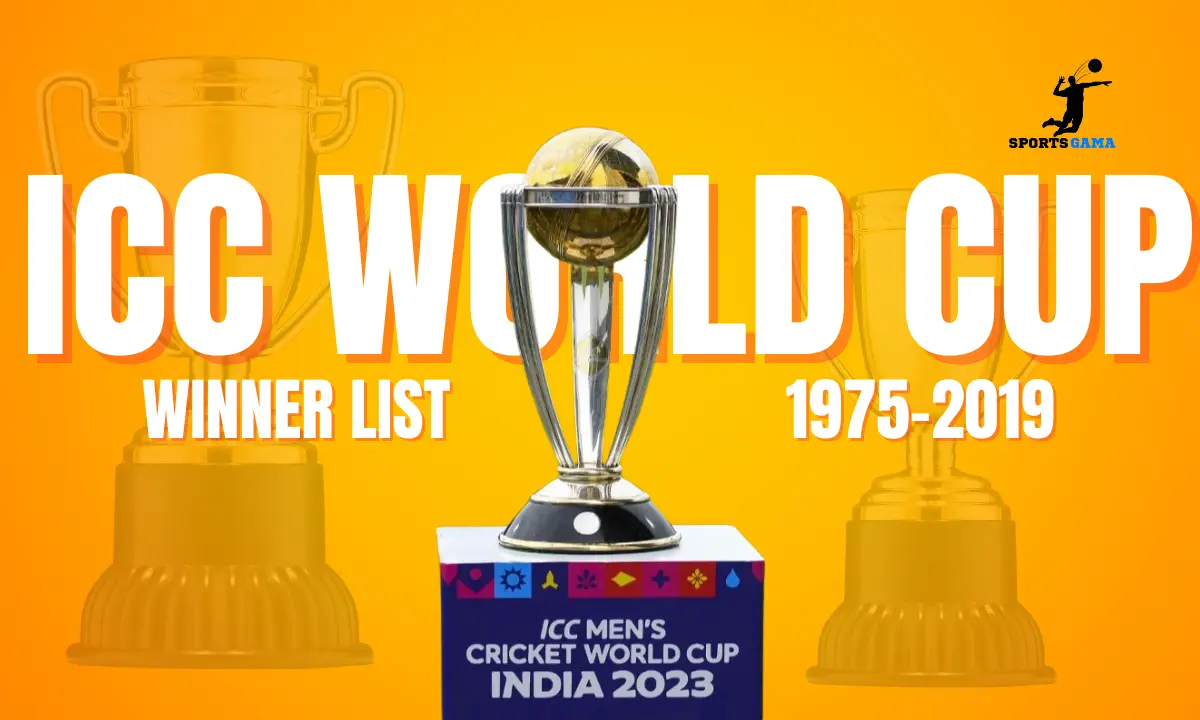
ICC World Cup Winners List 1975 to 2019: The ICC Cricket World Cup is considered the topmost platform of One Day Internationals, where nations clash for the ultimate honor of being crowned world champions. From the inaugural edition in 1975, this event has grown into a grand gala that pitches against each other the greatest cricketing nations slugging it out on the fields. From mere magic, drama to unforgettable triumphs- it has been quite a history over these years in this tournament. The following article details the history of winners of ICC World Cup from 1975 to 2019, mentioning the champions along with their respective routes toward being at the top.
1975: West Indies – The First World Champions
The year 1975 saw the first-ever ICC Cricket World Cup being staged in England and set an altogether new chapter in international cricket. Eight teams participated in that tournament; West Indies, under the lead of Clive Lloyd, were crowned as the first-ever winners of the World Cup. The final, at Lord’s, saw the Windies face off against Australia in a pulsating encounter. A cracking century by Clive Lloyd-102 runs off 85 balls-saw West Indies launch an attack on the opponents to reach a commendable total of 291/8. Australia did not give up and put up a good chase, but bowlers, particularly the menacing Andy Roberts and crafty Keith Boyce, saw that the West Indies ended with a victory of 17 runs. West Indies won in 1975. Thus, the trend was set for their dominance in the coming years.
1979: West Indies – Dominance Continues
The West Indies once again defended the title with quite some authority in the 1979 World Cup in England. Clive Lloyd’s men appeared imperious throughout, and in the final against host England at the Lord’s, a brilliant century by Vivian Richards of 138* propelled West Indies to a challenging total of 286/9. The English buckled under pressure in reply as Joel Garner and Michael Holding tore through their batting order. The West Indies won the match by 92 runs to become the first team to win successive World Cups. The victory in 1979 confirmed them as the undisputed champion force of world cricket then.
1983: India – A Historic Upset
The 1983 World Cup in England was going to see one of the major upsets in cricket history. India, under the captaincy of Kapil Dev, went into the tournament very much as underdogs but once again pulled off an astonishing reversal of fortunes to lift the trophy. India went on to play the mighty West Indies in the final at Lord’s, who were gunning for an unprecedented third successive title. Against an average score of 183 runs, India was bundled all out for the same. As it looked a mere formality for the West Indies to win, India bowled a miracle performance, with Mohinder Amarnath and Madan Lal bowling the West Indies out for a meager 140 for a mere difference of 43 runs, and Kapil’s innings of 175* in the group stage against Zimbabwe is considered one of the greatest ones ever played in the World Cup. The victory of 1983 set the spark for the coming generation of cricketers and changed the color of Indian cricket.
1987: Australia – The Rise of the Aussies
The 1987 Reliance Cup was the first World Cup to be played outside England and also co-hosted by India and Pakistan. It also saw the emergence of the Australians as world-beaters for the first time. Led by Allan Border, Australia went on to play England in the final match played at Eden Gardens in Kolkata, setting up a total of 253/5 with a valuable 75 by David Boon as Australia went on to win a nail-biting final with England giving them a run for their money too before losing the match by a slender 7 runs. These were the final men. This would lay the stepping stones for Australian cricketing dominance over the next decade or so.
1992: Pakistan – Imran Khan’s Cornered Tigers
The 1992 World Cup, held in both Australia and New Zealand, introduced several innovations: colored clothing, white balls, and day-night matches. Its story was one of rescue and triumph for Pakistan, captained by charismatic all-rounder Imran Khan. This was a must-win situation Pakistan found themselves in after a somewhat shaky start in their last group match. They won that and carried the momentum into the knockouts. In the final, at the Melbourne Cricket Ground, Pakistan found England. Imran Khan’s inspirational leadership and an all-round performance of high quality from Wasim Akram saw Pakistan through a 22-run victory. This has, over time, become one of the better-remembered speeches of Imran Khan, also known as his “cornered tigers” speech, and Pakistan’s 1992 victory is still touted as one of those moments celebrated with aplomb in cricketing history.
1996: Sri Lanka – The Fairy Tale
The 1996 World Cup, jointly staged by India, Pakistan, and Sri Lanka, had a new champion emerge in the form of Sri Lanka. This team played an aggressive brand of cricket under the captaincy of Arjuna Ranatunga, which rocked the cricketing world. They defeated the mighty Australians in the final at Lahore to capture their maiden World Cup title. Their success was majorly laid with the brilliance of their top-order batsmen, especially Sanath Jayasuria and Romesh Kaluwitharana, which changed the role of openers in ODI cricket. An unbeaten century by Aravinda de Silva in the final had laid the foundation for the Sri Lankan seven-wicket victory. The 1996 World Cup ushered in a new era when Sri Lanka joined the big boys in cricket.
1999: Australia – The Birth of an Era
In 1999, the World Cup returned to England and witnessed the recovery of the world championship by Australia. Steve Waugh’s Australian team marched one way through this tournament, culminating in an appearance in the finals against Pakistan at Lord’s. Because of Shane Warne, an off-spinner from Australia who took 4 wickets for 33 runs in a devastating spell, Australia bowled out Pakistan at a meager score of 132 runs. Australia chased the target comfortably and won the match by 8 wickets to win their second World Cup in history. This victory emerged as the beginning of the golden era for ODI cricket in the history of Australia, for they would go on to conquer the next two consecutive World Cups that came their way.
2003: Australia – Force Unleashed
The 2003 World Cup was a co-hosting event between South Africa, Zimbabwe, and Kenya. Australia continued its reign. Ricky Ponting took the place of Steve Waugh as captain of Australia, and with his captaincy, Australia remained undefeated in that tournament. In the final at Johannesburg against India, he played an innings that may find its place in the World Cup history-an unbeaten 140 from 121 balls. Australia amassed 359/2 and India could manage only 234 in return as Australia won the match by a comprehensive 125 runs. This was Australia’s third time to take the trophy of the World Cup, thus securing them as champions of the world game in the ODI format.
2007: Australia – A Hat-trick of Titles
The World Cup 2007 saw Australia, as usual, making the West Indian venture another chapter in cricketing history. Australia, too, had remained unbeaten this far, so ended up in the final played at Kensington Oval in Barbados against Sri Lanka. An electric 149 off 104 balls by Adam Gilchrist powered Australia to 281/4 in a rain-affected match. Sri Lanka fell short by 53 runs on the Duckworth-Lewis method in their chase. Australia’s win in 2007 seethed them into being the first-ever team to pull off a hat-trick of World Cup wins; a mark which till immediately was beyond the reach of even the most successful teams.
Also read: Eden Gardens Pitch Report: A Critical Study of the Fabled Cricket Venue
2011: India – The World Champions on Home Soil
The 2011 World Cup was co-hosted by India, Sri Lanka, and Bangladesh and it literally became a history making event in India. It all started under the captaincy of Mahendra Singh Dhoni in the most memorable way to reach this final. In the final at the Wankhede Stadium in Mumbai, India faced Sri Lanka. But in the fight, Sri Lanka gave them a tough time by scoring a good total of 274/6 courtesy of a sublime century by Mahela Jayawardene. India replied with a number of early falls, but eventually Gautam Gambhir’s 97 and an unbeaten 91 from MS Dhoni got India home by six wickets. The six which Dhoni hit to bring up the win is still fresh in the minds of all the cricketing fraternity. This was India’s victory in 2011, which ended a 28-year wait for their second World Cup title—it was a perfect farewell gift for the legend called Sachin Tendulkar, who bowed out during that edition, his last World Cup.
2015: Australia-Champions Once Again
The 2015 World Cup, being co-hosted by Australia and New Zealand, saw the Aussies return to the top of world cricket. There’s no denial that Australia, under the leadership of Michael Clarke, has been the most dominant force in this tournament as they faced New Zealand in the finals at the MCG with the Trans-Tasman rivalry of massive proportions. Australia bowled New Zealand out for only 183 runs with Mitchell Starc and James Faulkner the chief poisoners. They chased down the target rather comfortably and won by 7 wickets, thus securing their fifth world cup. This victory in the year 2015 had scripted another word of history for Australia in the pages mentioning them in the list of greatest cricket teams ever.
Year 2019: England – The Nervy Victory
The 2019 ICC World Cup in England will be long remembered as one of the most dramatic events ever to have been staged in cricket. In this format of the game, England, its inventors, had never won a World Cup before. Under the leadership of Eoin Morgan, they went into the tournament as one of the favorites. The final at Lord’s was an epic contest between hosts England and New Zealand. Both teams had to score 241 runs in their respective innings for them to enter into the first-ever Super Over in the World Cup final. Even the Super Over was a tie, but England was declared the winner on account of the boundary count rule wherein during the whole game, they had more boundaries. The win against New Zealand in 2019 was even more historic for England and a mark of their becoming one of the world-class ODI sides.
Conclusion – ICC World Cup Winners List 1975 to 2019
ICC Cricket World Cup is a major sporting event. Each one from 1975 to the latest in 2019 has a tale to tell about individual glory, heartbreak, and drama. At different times, different teams have risen to the occasion, as reflected in the list of winners-a reflection of the ever-changing dynamics of world cricket. From the supremacy of West Indies and Australia, to the Cinderella victories of India, Pakistan, and Sri Lanka, the World Cup has given its fans moments that are etched in the psyche forever. Let us pay our obeisance to the spirit of the game of cricket and the champions who have left their inerasable marks upon the game as we look back from 1975 to 2019 at the winners.
Also read: Sri Lanka National Cricket Team vs South Africa National Cricket Team Match Scorecard